
I have been diagnosed with Long Covid this year, so I’m learning to contend with POTS, chronic fatigue and other symptoms. Being out in the heat this summer wasn’t really an option for me. Now I am beginning to understand how it all works together, and I struggle to shift watering cans too.
I have varied the style of growing that I have used in the last five years since I took on my two current plots.
The main method I have focused on has been no-dig, which uses composted mulches on top of the soil structure and lets the weather and soil organisms combine it over time. Charles Dowding is the gardener and grower I have followed the most during this period; however, I find myself becoming increasingly switched off by his content and Facebook groups associated with the techniques he espouses. My main frustrations are that, in these digital communities that I have joined to learn more about no-dig, there is very little flexibility to discuss or think about alternatives. Some Facebook groups only really engage with discussions involving composted mulches, so if you try to talk about alternatives like Ruth Stout’s deep mulching techniques or lasagne techniques (layered mulching), you get told things like these will be a haven for slugs, which will then eat your seedlings. How many slugs did you see this summer? They are beginning to emerge now, but this is the first time since April for me. What I have seen are huge great cracks in my clay soil, which can be up to a metre deep, so I am critically rethinking how I grow there next year. This is why different ways of gardening like Ruth Stout, that originated in the US and might offer ideas for adapting to climate change and more unpredictable weather, appeal to me. I’m moving towards using more permaculture ideas in my gardening and growing and choosing to experiment more with mixing ideas and techniques rather than sticking to any one way.
The problem I’m having is finding a receptive community in which to share, explore and learn.
I understand particular approaches need to have boundaries, but I feel that in some cases these become overly dogmatic and ideological — which feels very like some of the issues that I take with research methods and paradigms, but that is another post. This is perhaps because gardening influencers have built up an audience or following over methods they claim as their own.
The first thing I am changing is to move to chop and drop. I had a health flare in the summer for about 8 weeks, starting in late June. A lot of my seedlings died; however, huge swathes of borage and calendula, along with salsify, campion, foxgloves and snapdragons, have taken root, which look beautiful. I am slowly clearing the beds and laying the plants across the spaces, whilst moving different species around to diversify the plants in different areas. To this I have added marigold and white mustard seed to act as a green manure. Despite the hot weather and my lack of tending, lots has grown — cucumbers, squashes, potatoes, tomatoes, cucamelon, chard, beetroots, carrots, onions and parsnips. I’m going to focus on these vegetables at the allotment next year, pulling out the flowers if they are in the way. Crops that are more water- or management-intensive, like peas or lettuces, I will grow at my house, which is on a direct north/south alignment, so I have two perfect microclimates in my front and back gardens to make use of.
Along with chop and drop and deep mulching (non-composted mulches), I am revisiting permaculture as a concept, which has easily used strategies for making the most of water retention and harvesting. These will be planting into deep wells (imprinting), creating berms and swales from woodchip on my allotment plot to stop runoff and using vegetation to manage things like evaporation. I have planted 3 willow trees to help with winter waterlogging at the bottom of my plot; however, willow grows voraciously, so the branches are heavily pollarded and left to die so they don’t take root when placed back on the ground. These will keep the majority of their leaves, so when they are safe to locate on the ground, they are placed around and on top of crops to shade them, which keeps off the wind and sun and minimises evaporation.
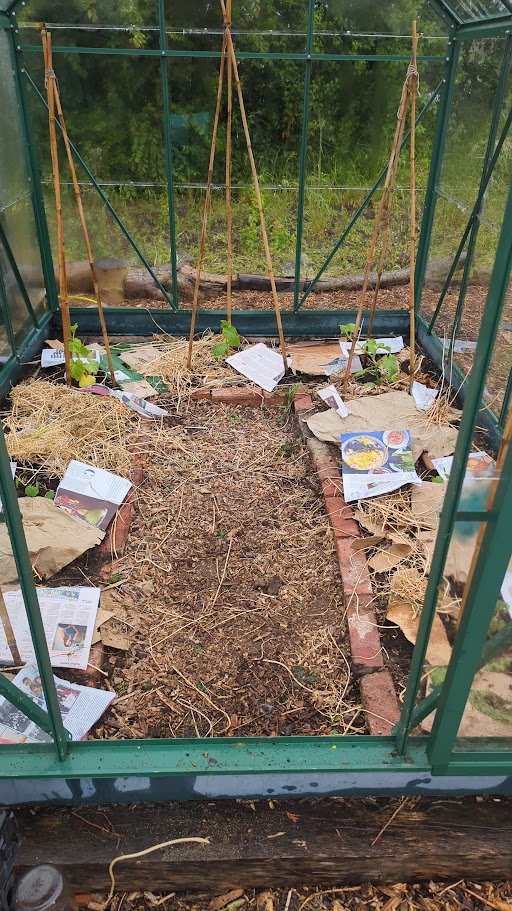
In my polytunnel and greenhouse, I have mulched the beds with whatever organic materials I can get my hands on — cardboard, plant cuttings, scrap paper, and even old clothing, as long as it is 100% cotton. I did this when I put my cucumber plants in and it is the reason, I think, why they have thrived and survived in the heatwaves even though they weren’t watered for nearly 3 weeks.
I’ve also recruited friends to help me with the space, so it is our allotment rather than my allotment.
This adds a social element to growing and the space, which is also brilliant for my mental health. I suspect that over time the community aspect of my allotment will move towards being in a space ‘out here’ with friends, humans, plants and all the forms of life that are moving into my growing space. It feels like there is more space for growth, more opportunity to try things out and make mistakes rather than being in the tightly confined restraint of an interface created and held by someone else, within which are further categories that I need to restrict myself to participate in. I am losing my fondness for large socially networked and mediated groups, even those organised around interests that still appeal to me.