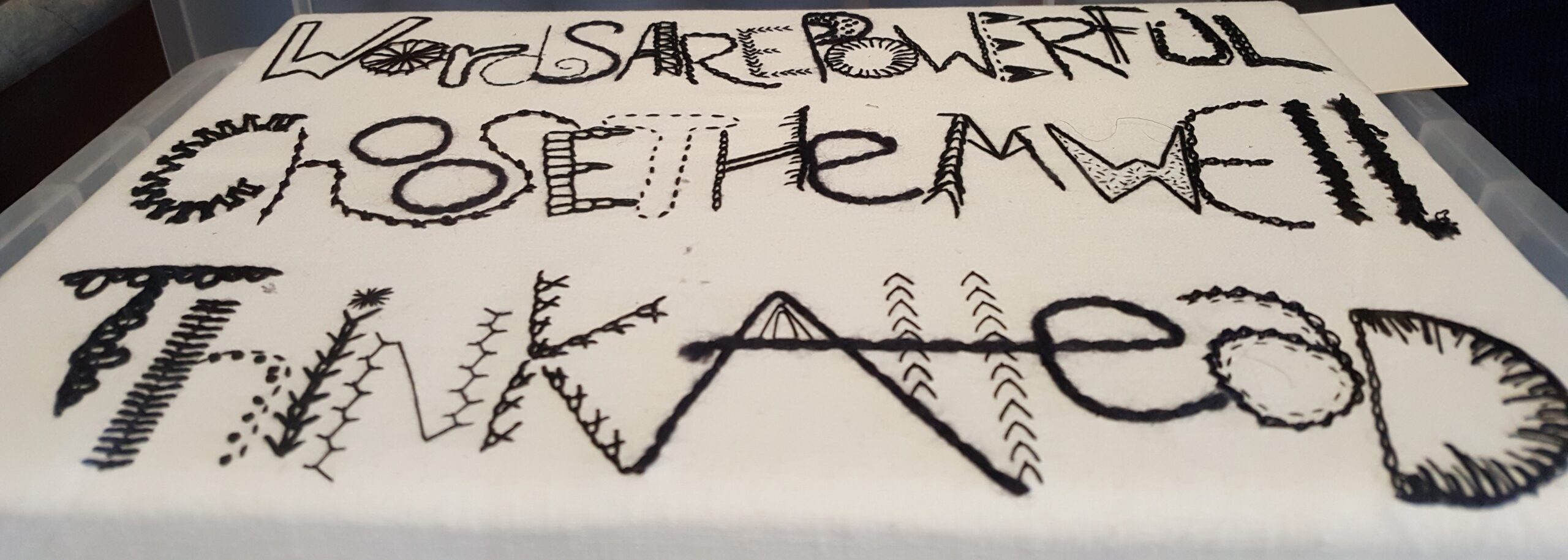
I listen to a lot of music. It helps me process my emotions, recognise my emotional state in the moment and regulate my sensory system. This latter aspect was highlighted in the sensory profile that was created within my inpatient care plan; that I use music, in surprising ways, within the context of my sensory diet.
Music expresses my emotional state better than I ever can verbally and usually in writing. It’s an example of my personal beyond-language communication. A different extrapolation of the same phenomena that was described be a co-author who drew images to express emotional states and knowledges and was sometimes the only speaker of the language in question (Jackson Perry et al., 2020).
The exploration of my digital personal data, in the early days of my PhD, led me to recognise that curated lists of content, for example bookmarks, music or video playlists, are an important part of digital personal expression in data which had versatile and subtle uses. Meaning emerges from these sites in unexpected ways. My YouTube music recap from September to November 2025, broadly covering the period I was hospitalised and detained, offers insight into my emotional states and their neurodivergent expression when I seriously ill, experiencing despair and desiring to die. Perhaps you might follow the link and listen to it whilst you read the remainder of this essay.
The individual songs collected by YouTube’s recap are evocative and insightful, in unanticipated ways.
Phoebe Bridgers ‘Funeral‘ conveys the alternating guilt and dejection of long term and severe negative emotional states. Max Richter’s, ‘On the Nature of Daylight‘ was the song I intended to end my life to, encompassing in my imagination, when trapped in a tiny grey room with very little natural light or sound: the beauty of a sunset; the bittersweet nature of life and living; the experience of slipping backward into unconsciousness, in the strands of it’s melody. It is the saddest and most beautiful piece of music.
Searows was an artist I discovered by change following algorithmic recommendations provided by YouTube after listening to Phoebe Bridgers. Two Searows tracks ‘I can and I will’ and ‘To be seen‘ became fundamental in my music habits during these three months. They were played repeatedly over and over, expressing my need in hospital, to stim, cycling back and forth through something familiar and comforting when I could not move in my instinctively autistic way, for fear of the normative standards that are the benchmark for stable behaviour in hospital. These are enforced, like Foucault’s panopticon (Foucault, 1995) through virtual and in-person monitoring twenty-four hours of every day.
Foucault's panopticon.
A straight line.
Staring down at me, meeting my eye
every hour of the day.
Unblinking.
The red eye of Sauron
Repeating.
Reaching through
my optical nerve, into the fibres
of my being.
Here in hospital.
My chest rises (and falls)
like the day.
My heart beats.
Measured and reported.
Repeating,
to my wardens.
As the ache inside of me,
my heart,
longs for home.
The masking of my movement, my embodied ways of knowing myself and my neurodivergence (Bertilsdotter Rosqvist et al., 2025) was not conscious. Rather, my compulsion to camouflage and mask (ibid) is ingrained and instinctive, an unwelcome synthesis (Perlow, 2019) that I cannot separate from my authentic selfhood. This music helps me define myself and it. Draw the line and establish where I end and it begins. Understand what is performance and what is me. Offers a place of resistance from which to regain myself. As Searows sings in ‘to be seen’ “Is this the face that you gave to me? / Do I belong to myself? / Am I the same when you look at me? / Or am I somebody else?” an ironic lyrical round to fixate upon when I think about the many thousands of pages of data that I have generated during a three month inpatient stay.
Knowing the system inside and outside makes it easier to understand the spaces you can quietly inhabit and be yourself. Sometimes these exist in the physical tangible domain. For example, in hospital, the only place where you could guarantee you would not be observed through a door pane or camera was the toilet. This was why I resorted to sleeping on the floor of mine for several night. This and because it was the only place that I was able to maintain some degree of control over the sensory onslaught of noise, of smell and of light that was imposed upon me every fifteen minutes on level three ‘obs’.

Sometimes the places exist, as it did for me, in the digital domain. Like this recap, music was the place and way that I was able to express myself autistically, neurodivergently in a way that passed for normal. Part of the trick, as it were is to understand the borderline, the boundary that you need to skirt along in order to achieve what you need. Sometimes you need to be sane. Other times you need to be mad. Sometimes you are mad and can’t show it – like I needed to be in hospital. The idea of being detained on a section 3 was terrifying at the time. Being in hospital for up to half a year was terrifying. Being stuck on repeated section 3s was even more terrifying; a reality documented by other autistic women/female perceived people (Quinn, 2022).
So, this blog becomes another digital place where I can be myself. A sanctuary to retreat to when I need to be myself. Not an academic/ a partner/ a parent / a citizen / a tenant. As I did with and through music when I lived on the border, for a little, while between lifeing and deathing.
- Bertilsdotter Rosqvist, H., Day, A., & Krazinski, M. (Eds). (2025). Exploring autistic sexualities, relationality, and genders: Living under a double rainbow. Routledge. https://doi.org/10.4324/9781003440154
- Foucault, M. (1995). Discipline and punish: The birth of the prison (2nd Vintage Books ed). Vintage Books.
- Jackson Perry, D., Bertilsdotter Rosqvist, H., Layton Annable, J., & Kourti, M. (2020). Sensory strangers: Travels in normate sensory worlds. In H. Bertilsdotter Rosqvist, N. Chown, & A. Stenning (Eds), Neurodiversity Studies (pp. 125–140). Routledge.
- Perlow, E. (2019). ADULT WOMEN WITH AND WITHOUT AUTISM SPECTRUM DISORDER: PERSPECTIVES ON THE MENARCHE/MENSTRUATION EXPERIENCE [Master of Arts]. Texas Women’s University.
- Quinn, A. (2022). Unbroken: Learning to live beyond autism diagnosis. Welbeck Balance.
